


Q235 and ASTM A36 are both common mild-carbon structural steels, but they belong to different standards and are not formally equivalent or freely interchangeable. The biggest practical difference is that Q235 is a Chinese structural steel grade under GB/T 700, while A36 is a US structural steel grade under ASTM A36 for plates, shapes, and bars
What Is Q235 Steel?
Q235 is the most popular Chinese mild carbon structural steel defined in GB/T 700.
"Q" stands for yield strength; "235" means minimum yield strength 235 MPa for thickness ≤16 mm.
It has four subgrades: Q235A / Q235B / Q235C / Q235D, differentiated by Charpy impact requirements:
| Steel Grade | Impact Test Temperature | Main Characteristics |
| Q235A | No impact test required | General structural applications |
| Q235B | +20°C | Commonly used structural grade |
| Q235C | 0°C | Better specified low-temperature impact performance |
| Q235D | -20°C | Suitable for applications requiring better low-temperature toughness |
Tensile strength range: 370–500 MPa
Good ductility, easy welding and cold forming. Widely made into steel pipe, profiles, plate for domestic construction, supports, low-pressure fluid piping and general fabrication.
Common Applications of Q235 Steel
Q235 is widely used in:
- Welded carbon steel pipes
- Square and rectangular hollow sections (SHS/RHS)
- Steel scaffolding systems
- Structural steel frames and supports
- Construction machinery components
- Industrial equipment and fabrication
For steel pipe manufacturers, Q235B is a common material choice for producing round welded pipes and structural hollow sections, provided the selected pipe manufacturing
What Is ASTM A36 Steel?
ASTM A36 is the dominant North American hot-rolled structural carbon steel under ASTM A36 / A36M.
"36" refers to its minimum yield strength: 36 ksi = 250 MPa (for thickness ≤200 mm).
Tensile strength range: 400–550 MPa
Default standard: no mandatory Charpy impact test unless specially ordered on the purchase order.
Chemistry is property-focused: only maximum limits for C, Mn, P, S, no required minimum carbon.
Common forms: pipe, plate, H-beam, angle, channel for US/Canada building frames, bridges, structural supports and export structural piping.
Common Applications of ASTM A36 Steel
ASTM A36 is commonly used in:
- Structural steel beams and columns
- Steel plates and fabrication components
- Bridge structures
- Industrial equipment frames
- Building construction
- General steel fabrication
An important point for pipe buyers is that ASTM A36 is not a dedicated steel pipe specification.
Q235 vs A36: Key Differences
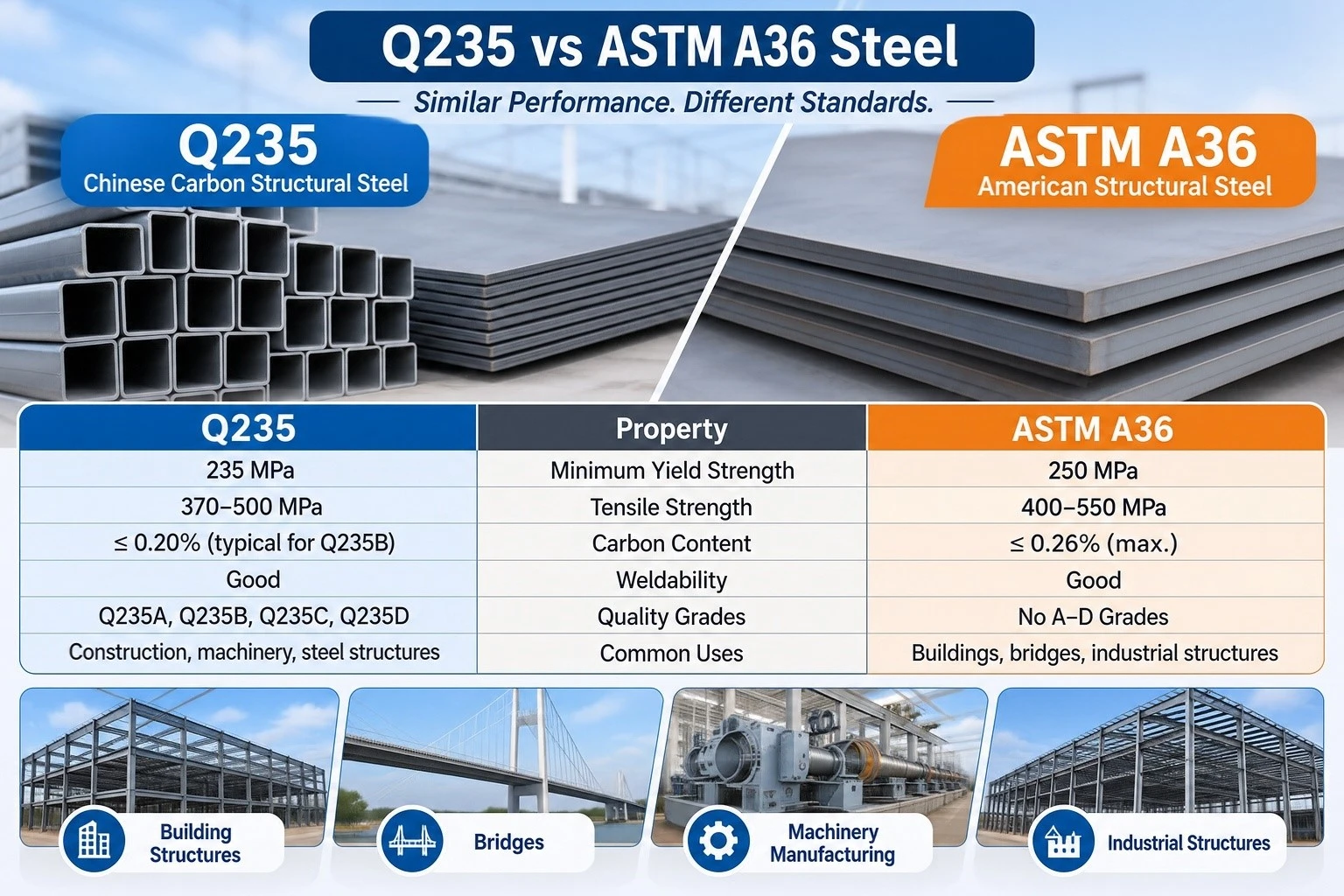
| Item | Q235 | ASTM A36 |
| Standard | Chinese GB/T 700 | US ASTM A36 / A36M |
| Min Yield (≤16mm) | 235 MPa | 250 MPa |
| Tensile Strength | 370–500 MPa | 400–550 MPa |
| Elongation (min) | ≥26% | ≥23%(50 mm gauge) |
| Charpy Impact | Graded by temperature (A: none; B:20°C; C:0°C; D:-20°C) | No default Charpy requirement |
| Carbon max | ≤0.22% for Q235A; tighter for B/C/D | 0.26% |
- Yield Strength: ASTM A36 has a higher specified minimum yield strength than Q235B when comparing products within the applicable thickness ranges. This means A36 can generally withstand slightly higher stress before permanent deformation.
- Tensile Strength: A36 has a higher specified minimum tensile strength, although the two grades have overlapping strength ranges.
- Carbon Content: Carbon affects steel strength, hardness, and weldability. Q235B has a specified carbon limit of 0.20% under the cited GB/T 700-2006 requirements, while A36 allows different limits depending on product specifications.
Is Q235 Equivalent to ASTM A36?
No, they are NOT official, full equivalents.
They are similar mild structural steels, both weldable and widely used for steel pipe. But they belong to separate standard systems with different guaranteed values and test rules.
Q235B is often called a "commercial substitute" for A36 in trade, but this is only a loose practical similarity, not formal code equivalence.
Can Q235 Steel Replace A36 in Structural Pipe Applications?
Generally not without approval. Several issues must be checked:
- Strength: Q235's 235 MPa minimum yield is lower than A36's 250 MPa. A direct substitution may reduce capacity by roughly 6% before other factors.
- Pipe standard: Structural pipe is often specified to ASTM A500, not A36. A500 Grade B has a much higher yield than both Q235 and A36. Replacing it with Q235 would be a significant downgrade unless redesigned.
- Toughness/impact: If the design requires impact testing, use Q235B/C/D or the specified grade-not generic Q235A.
- Dimensions/tolerances: Metric vs inch sizes, wall thickness, corner radii, straightness, and mass tolerances may differ.
- Welding and certification: The welding procedure and project documentation must cover the substitute grade.
- Code approval: Structural, pressure, seismic, or safety-related work usually requires the engineer of record or authority to approve any substitution.
Q235B may be considered as a substitute only after checking the actual pipe specification, design capacity, impact requirements, tolerances, and certification. Do not substitute solely because "Q235 and A36 are both mild steel."
Which Steel Grade Should You Choose for Carbon Steel Pipes?
Choose based on the pipe standard and service, not just Q235 vs A36:
| Application | Typical choice |
| General structural tubing/pipe, US project | ASTM A500 Grade B/C |
| General welded water/air/low-pressure pipe | ASTM A53 or GB/T 3091 Q235B |
| High-temperature/pressure service | ASTM A106 |
| Line pipe/oil & gas | API 5L |
| Chinese/metric general structural fabrication | Q235B to the applicable GB pipe/tube standard |
| US structural steel plates/shapes/bars | ASTM A36 |
Q235 and A36 are similar but not equivalent. For carbon steel pipe, specify the actual pipe standard-A53, A500, A106, API 5L, GB/T 3091, etc.-and then the grade. A36 is usually the wrong starting point for pipe selection, and Q235 should not replace an A36/A500 pipe without engineering verification.
If you are selecting carbon steel pipes for your project, for more standard of steel pipes,feel free to contact us with your required standard, size, and quantity for a quick quotation


