


Coated Steel Pipe

Product Name: FBE Coated Steel Pipe,Epoxy Coated Carbon Steel Pipe,Plastic Coated Steel Pipe,SPC Pipe,PE Steel Pipe
Production Range:
| Bare Pipe | ERW | SMLS | SSAW | LSAW |
| Size | 1/2"-24" | 1/2"-24" | φ219~φ4200mm | 16"-64" |
Coating Type:Galvanized Coating /3PE /2PE/FBE/2FBE/3PP Varnish Coating Bitumen Coating /Black Oil Coating,Cement coated as per customer's requirement.
Pipe End:Plain End, Bevelled End, Grooved End,Threaded End,Flanged End , Spigot & Socket , Special End
Color:typically red, green, blue, grey, or custom
Length: usually 5.8m or 6m or 12m
Application: Widely used in fire protection water supply systems, building potable water conveyance, chemical fluid transportation, cable conduit protection, gas pipeline transmission and other fields.

Grooved End
Circular grooves are machined on pipe ends. Pipes are joined by flexible grooved couplings.
Features: Fast installation, vibration damping, allowing slight angular deflection. No welding required.
Application: Fire protection systems, water supply & drainage, building piping and quick-assembly projects.
Threaded End
Tapered or straight threads are cut on pipe ends. Pipes are connected by threaded fittings.
Features: Simple structure, compact connection. Limited to small sizes and low pressure.
Application: Small-bore branch pipes, instrument lines, low-pressure water and gas pipelines.


Flanged End
Pipe ends are pre-welded with flanges. Connection is achieved by bolting two matching flanges together with gaskets for sealing.
Features: High rigidity, good tightness, easy disassembly and maintenance.
Application: Pump stations, valve connections, industrial process pipelines and main distribution lines.
Spigot & Socket
One pipe end is a spigot (male end) and the other is a socket (female end). A rubber gasket is fitted inside the socket for sealing during insertion.
Features: Flexible connection, good adaptability to ground settlement and displacement. Weld-free installation.
Application: Municipal water supply, sewage pipelines, buried pipelines.

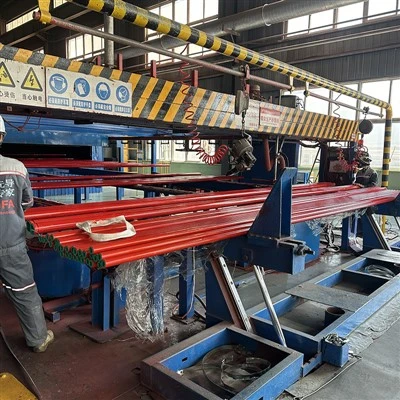
FBE Coated Pipe
Epoxy Coated Pipe
3PE Coated Pipe
Concrete Coated Pipe
FBE Coated Pipe
FBE Coated Pipe (Fusion Bonded Epoxy Coated Pipe) is a steel pipe that has a protective layer of thermosetting epoxy powder applied through a fusion bonding process. The epoxy coating is chemically bonded to the steel surface, creating a hard, continuous, and corrosion-resistant barrier.
- Surface Preparation – The steel pipe is abrasive-blasted (typically to Sa 2.5 or white metal finish) to ensure cleanliness and surface roughness.
- Heating – The pipe is induction-heated to approximately 200–250°C (400–480°F).
- Powder Application – Dry epoxy powder is electrostatically sprayed onto the hot pipe surface.
- Fusion & Curing – The powder melts, flows, and chemically reacts (cross-links) to form a smooth, continuous film. The coated pipe is then quenched with water to set the coating.
- Inspection – The finished coating is tested for pinholes (holiday detection), thickness, and adhesion.

Epoxy Coated Pipe
Epoxy Coated Pipe is a steel pipe that has a protective layer of epoxy resin applied to its internal and/or external surface. The epoxy coating provides excellent corrosion resistance, chemical protection, and a smooth finish. Unlike FBE (fusion bonded epoxy), which is a specific thermoset powder coating, “epoxy coated pipe” is a broader term that can include both liquid epoxy coatings and powder epoxy coatings (including FBE) .
- Surface Preparation – The steel pipe is abrasive-blasted to a clean, rough surface (typically Sa 2.5 or white metal).
- Application – Epoxy is applied either as a liquid (spray/brush) or as a powder (electrostatic spray onto heated pipe).
- Curing – The coating is allowed to cure (for liquid epoxy, chemical reaction; for powder, heat fusion).
- Inspection – Coating thickness, adhesion, and pinhole-free condition are checked.

Types of Epoxy Coatings
| Type | Application Method | Curing | Typical Use |
| Liquid Epoxy | Brushed, rolled, or sprayed at ambient temperature | Requires a hardener or air drying | Field repair, small-diameter pipes, tank linings |
| Powder Epoxy (FBE) | Electrostatic spray onto pre-heated steel (200–250°C) | Thermal fusion (melts and chemically bonds) | Factory-applied, buried pipelines, fire sprinkler internal coating |
| Note: FBE (Fusion Bonded Epoxy) is a high-performance subset of epoxy coated pipe. | |||
3PE Coated Pipe
3PE Coated Pipe (Three-Layer Polyethylene Coated Pipe) is a steel pipe with a multilayer anti-corrosion coating system consisting of three distinct layers: an epoxy primer, an adhesive copolymer, and an outer polyethylene layer. This combination provides excellent corrosion resistance, strong adhesion, and superior mechanical protection, making it the industry standard for buried and subsea pipelines.
- Surface Preparation – Steel pipe is abrasive-blasted to Sa 2.5 (white metal) and heated.
- Epoxy Application – Epoxy powder is electrostatically sprayed onto the hot pipe (≈200–250°C), where it melts and chemically bonds.
- Adhesive Application – While the epoxy is still reactive, the copolymer adhesive is extruded or side-wrapped onto the pipe.
- PE Extrusion – Molten polyethylene is extruded over the adhesive layer, forming a continuous, seamless jacket.
- Cooling – Water quenching solidifies the coating.
- Inspection – Holiday detection, thickness measurement, and adhesion tests are performed.

Layer Structure (from steel outward)
| Layer | Material | Function |
| Layer 1 (Inner) | Fusion Bonded Epoxy (FBE) | Provides chemical adhesion to steel and primary corrosion protectio |
| Layer 2 (Middle) | Copolymer adhesive | Bonds the epoxy to the polyethylene layer |
| Layer 3 (Outer) | Polyethylene | Delivers mechanical strength, impact resistance, abrasion protection, and oxygen |
| Total coating thickness: typically 2–5 mm, depending on pipe diameter and service conditions. | ||
Concrete Coated Pipe
Concrete Coated Pipe (also known as Concrete Weight Coated Pipe) is a steel pipe that has an outer layer of reinforced or unreinforced concrete applied over the primary anti-corrosion coating. The concrete layer is not for corrosion protection – its main purposes are to provide negative buoyancy (preventing the pipe from floating) and mechanical protection against impact, abrasion, and external loads.
- Prepare steel pipe – The pipe is first coated with FBE or 3PE for corrosion protection.
- Apply bonding layer (optional) – A primer or adhesive may be sprayed to improve concrete adhesion.
- Concrete application – Methods include:
Impingement (spray) method – High-speed spray of wet concrete onto the rotating pipe.
Compression (tamping) method – Concrete is compacted around the pipe with mechanical forms. - Curing – The concrete is moist-cured to achieve full strength.
- Inspection – Thickness, density, and crack detection are verified.

Typical Layer Structure (from inside out)
| Layer | Material | Function |
| 1. Steel pipe | Carbon steel (API 5L, ASTM A53, etc.) | Pressure containment and structural strength |
| 2. Anti-corrosion coating | FBE, 3LPE, or 3LPP | Corrosion protection (applied before concrete) |
| 3. Concrete weight coating | Dense concrete (with or without steel reinforcement) | Adds weight, impact resistance, and protection |
| Sometimes an intermediate layer (e.g., a mastic or epoxy primer) is used to bond concrete to the anti-corrosion coating. | ||



Application by Coating Type
- FBE Coated Pipe (Fusion Bonded Epoxy)
Fire protection systems: Automatic sprinkler pipes, fire water mains (most popular choice).
Industrial pipelines: High-temperature medium pipes, chemical pipelines, oil & gas gathering lines.
Water supply & drainage: Indoor/outdoor water pipes, high-pressure service lines.
Other: Power plant piping, seawater pipelines, pipelines with strict abrasion resistance requirements.
- Liquid Epoxy Coated Pipe
Civil buildings: Indoor water supply pipes, domestic drainage pipes, building branch lines.
General municipal works: Low-pressure buried water pipelines, sewage pipes.
On-site renovation & repair: Field re-coating for damaged steel pipes.
Low-budget projects: Ordinary non-critical pipeline systems.
- 3PE / 3LPE Coated Pipe
Long-distance buried pipelines: Oil, natural gas and large-diameter water transmission trunk lines.
Municipal buried networks: Underground water supply, gas pipelines across urban areas.
Crossing projects: Road crossing, railway crossing pipelines.
Remote field pipelines: Pipeline systems in wild areas with complex soil conditions.
- Concrete Coated Pipe (CWC)
Submarine & offshore pipelines: Offshore oil/gas pipelines, subsea water pipelines.
River & lake crossing pipelines: Prevent floating and resist water flow impact.
Underwater projects: Port, dock and underwater pipeline systems.
Deep buried pipelines: Pipelines under heavy overburden or strong extrusion.
Quick Comparison Table
| Feature | Epoxy Coated Pipe | FBE Coated Pipe | 3LPE (3PE) Coated Pipe | Concrete Coated Pipe |
| Full name | Epoxy coated steel pipe | Fusion Bonded Epoxy coated steel pipe | Three‑layer Polyethylene coated steel pipe | Concrete weight coated steel pipe |
| Coating type | Organic (liquid or powder epoxy) | Organic (thermoset epoxy powder) | Multi‑layer: Epoxy + adhesive + PE | Mineral (concrete) weight coating |
| Primary function | Corrosion protection (mild to moderate) | Corrosion protection (high performance) | Corrosion + mechanical protection | Negative buoyancy + impact protection |
| Impact resistance | Low to moderate | Moderate | High (thick PE outer layer) | Very high (concrete absorbs impact) |
| Typical application | Water lines, sewage, fire sprinkler internal coating | Buried pipelines, rebar, external coating for gas/water | Long‑distance oil/gas, subsea pipelines, rocky terrain | Submarine pipelines, river crossings, wetlands |