


C channel and square tubing are both widely used structural steel sections, but they behave differently under load.
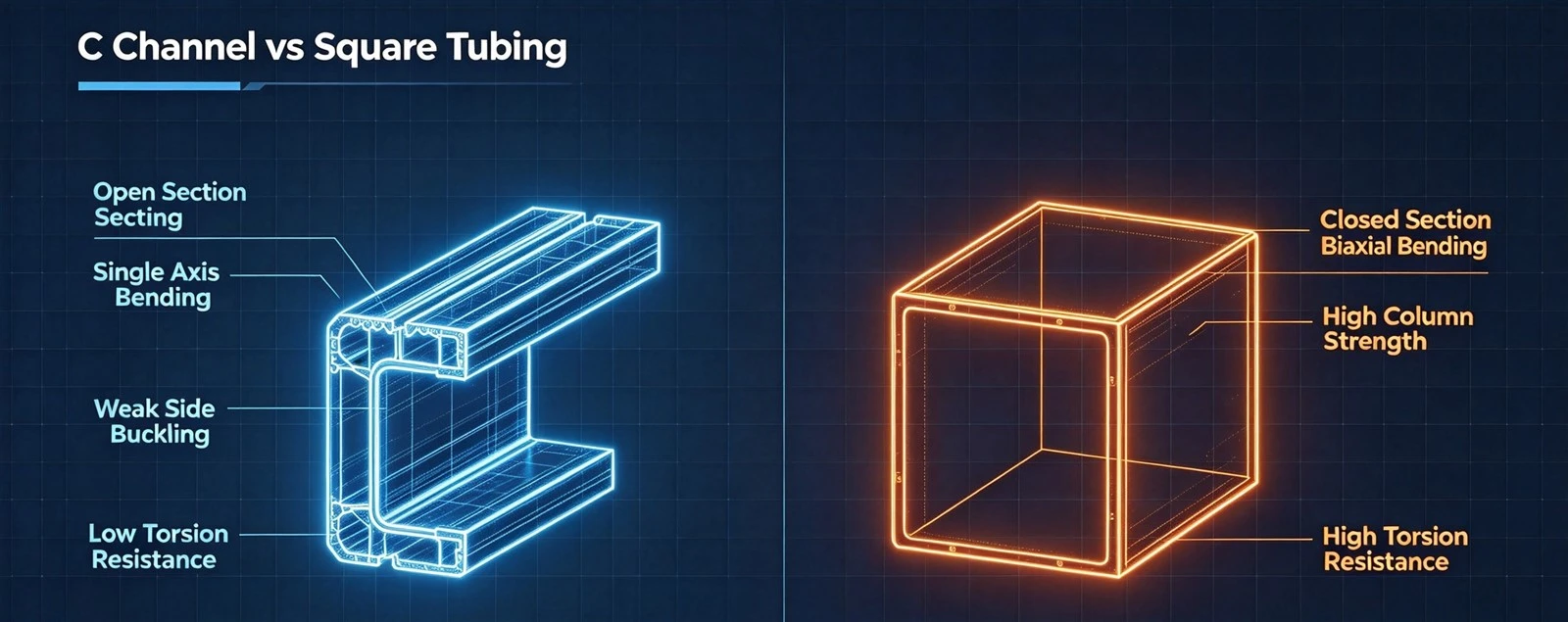
- Square tubing (closed HSS) is far better for compression, biaxial bending, torsion (twist)
- C‑channel (open section) is efficient only for single‑axis strong‑axis bending
| Feature | C-Channel | Square Tubing |
| Shape | Open 3-sided profile | Closed 4-sided profile |
| Torsion (Twisting) Resistance | Low (tends to twist under off-center loads) | High (closed box resists twisting) |
| Bending Strength | Strong along its main vertical axis | Equal strength in all directions |
| Connection & Assembly | Easy to drill, bolt, and access internal sides | Easy to notch, fit, and flush-weld on 4 sides |
| Corrosion Resistance | Open interior prevents moisture collection | Sealed ends required to prevent interior rusting |
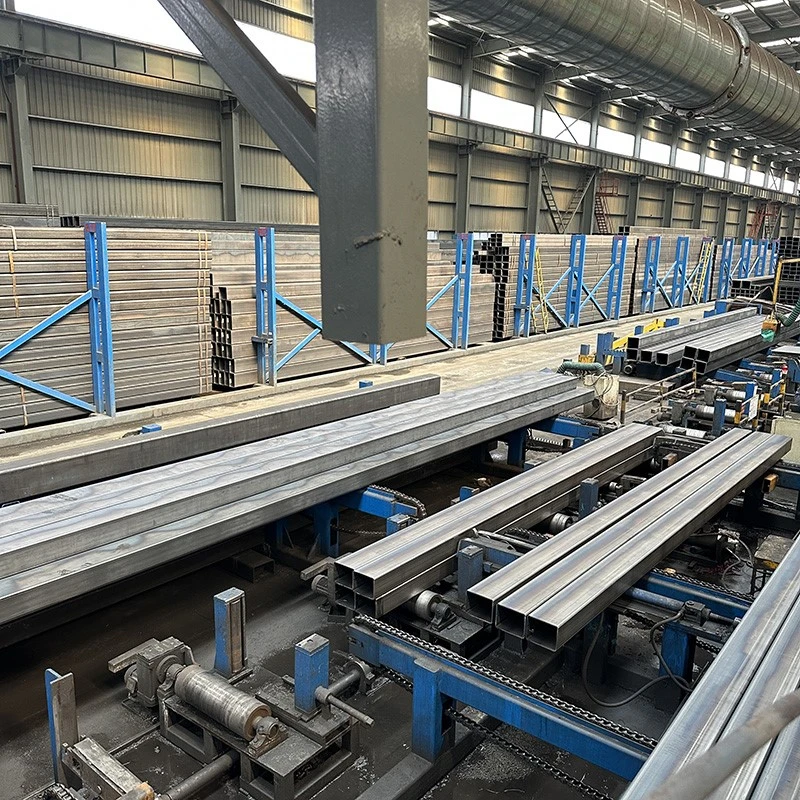
Key Differences
- Closed vs. Open Geometry
Square Tubing (Closed Profile): Because all four walls are welded together, energy and forces flow continuously around the shape. This makes it rigid, highly resistant to twisting, and equally stable in every direction.
C-Channel (Open Profile): Because one side is open, it has a "strong axis" and a "weak axis". If a side-load or twisting force is applied to a C-channel, it tends to twist and buckle much easier than a closed box tube.
- Practical Fabrication & Utility
C-Channel is easier to bolt and access: You can easily drill through a single wall and attach nuts, bolts, or brackets to the open side.
Square Tubing is easier to weld and frame: Flat, uniform sides make it simple to fit up, notch, and weld for 3D structures, vehicle frames, and equipment stands.
When to Use Which?
If you're making a beam (spanning between two supports, carrying a vertical load – e.g., a carport roof): C‑channel is more cost‑effective – for the same weight, it's taller, so it resists bending better.
If you're making a column (vertical support), a cantilever arm, or anything that sees twisting or side loads (e.g., trailer frames, crane booms): Square tubing is definitely stronger – it won't twist or buckle sideways.
If you're not sure about the load direction: Always choose square tubing – it's the safer all‑rounder.
Frequently Asked Questions
Q:Can square tubing replace C channel?
A:In some structural applications, yes. However, square tubing may be heavier or more expensive for applications where an open C section provides sufficient bending capacity. The replacement should be based on engineering calculations rather than nominal size.
Q:Which is better for a steel frame?
A:For a rigid frame, square tubing is often the better choice because it provides good bending strength in both directions and high torsional resistance. C channel is often preferred for open frames, beams, purlins, and structures where convenient connections are important.
Q:Which is easier to weld, C channel or square tubing?
A:Both are relatively easy to weld when using compatible mild-steel grades. C channel provides easier access to its surfaces, which can simplify some connections. Square tubing may require more attention when welding corners and closed sections.
Q:Which is better for outdoor applications?
A:Both can be used outdoors if properly protected against corrosion. Hot-dip galvanized square tubing or C channel provides better long-term corrosion protection than bare mild steel. Painting or other protective coatings can also be used depending on the environment.


