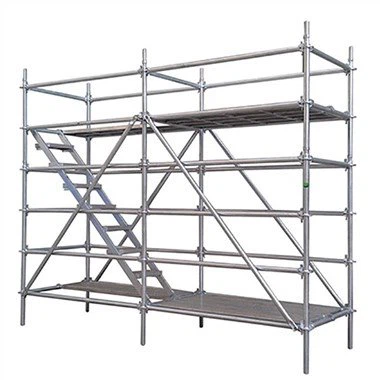
As a supplier of steel planks, I've witnessed firsthand the crucial role that hardness plays in the performance and durability of these essential construction materials. In this blog post, I'll delve into the concept of steel plank hardness, exploring its significance, measurement, and the factors that influence it.
Understanding Hardness in Steel Planks
Hardness is a fundamental property of steel that refers to its resistance to deformation, indentation, or scratching. In the context of steel planks, hardness is a critical factor that determines their ability to withstand heavy loads, abrasion, and impact during construction projects. A harder steel plank is generally more durable and less prone to wear and tear, making it a preferred choice for high - stress applications.
Why Hardness Matters in Steel Planks
- Load - Bearing Capacity: Steel planks are often used as scaffolding walkways or catwalks, where they need to support the weight of workers, tools, and materials. A hard steel plank can better distribute the load and resist bending or breaking under heavy stress. For example, in large - scale construction sites where heavy machinery and equipment are moved across the planks, a high - hardness steel plank ensures the safety and stability of the working platform.
- Abrasion Resistance: Construction sites are full of abrasive materials such as gravel, sand, and concrete. Steel planks with high hardness are more resistant to abrasion caused by the movement of these materials. This means that the surface of the plank will not wear down quickly, maintaining its smoothness and structural integrity over time. For instance, on a demolition site where debris is constantly being dragged across the planks, a hard - surfaced steel plank will last much longer than a softer one.
- Impact Resistance: Steel planks may be subjected to impacts from falling objects, tools, or machinery. A hard steel plank can absorb and dissipate the energy from these impacts without cracking or deforming. This is especially important in high - risk construction environments where the risk of falling objects is high. For example, in a multi - story building construction, if a tool accidentally falls on a steel plank, a hard plank can prevent damage that could compromise the safety of the workers.
Measuring the Hardness of Steel Planks
There are several methods to measure the hardness of steel planks, and the most commonly used ones are the Brinell, Rockwell, and Vickers hardness tests.


- Brinell Hardness Test: In this test, a hardened steel ball is pressed into the surface of the steel plank under a specific load for a set period of time. The diameter of the indentation left on the surface is then measured, and the Brinell hardness number (BHN) is calculated based on the load and the diameter of the indentation. The Brinell test is suitable for measuring the hardness of relatively large and thick steel planks.
- Rockwell Hardness Test: The Rockwell test uses a diamond cone or a hardened steel ball indenter. The indenter is first applied with a minor load to set the initial position, and then a major load is applied. The difference in the depth of penetration between the minor and major loads is measured, and the Rockwell hardness number is determined. This test is quick and can be used on a variety of steel plank thicknesses.
- Vickers Hardness Test: Similar to the Brinell test, the Vickers test uses a square - based diamond pyramid indenter that is pressed into the steel surface under a known load. The diagonal length of the indentation is measured, and the Vickers hardness number (HV) is calculated. The Vickers test is very accurate and can be used for measuring the hardness of small areas or thin steel planks.
Factors Affecting the Hardness of Steel Planks
- Chemical Composition: The chemical composition of steel has a significant impact on its hardness. Elements such as carbon, manganese, chromium, and nickel can increase the hardness of steel. For example, carbon is one of the most important elements in steel. As the carbon content increases, the hardness of the steel also increases. However, too much carbon can make the steel brittle, so a balance needs to be struck.
- Heat Treatment: Heat treatment is a process used to alter the microstructure of steel, thereby changing its hardness. Processes such as quenching and tempering can significantly increase the hardness of steel planks. Quenching involves rapidly cooling the steel from a high temperature, which forms a hard and brittle microstructure. Tempering is then performed to reduce the brittleness and improve the toughness of the steel while still maintaining a high level of hardness.
- Manufacturing Process: The way steel planks are manufactured can also affect their hardness. For example, hot - rolled steel planks may have a different hardness compared to cold - rolled ones. Cold - rolling can increase the hardness of steel by work - hardening the material, which occurs when the steel is deformed at room temperature.
Our High - Quality Steel Planks
At our company, we understand the importance of hardness in steel planks. We source the highest - quality steel materials with the optimal chemical composition and use advanced heat treatment and manufacturing processes to ensure that our steel planks have the right level of hardness for various construction applications.
We offer a wide range of steel planks, including Scaffolding Walk Planks, Plank Steel, and Catwalk Board Scaffolding Steel Plank. Our scaffolding walk planks are designed to provide a safe and stable walking surface with high load - bearing capacity and excellent abrasion resistance. The plank steel we offer is carefully engineered to meet the strictest industry standards for hardness and durability. And our catwalk board scaffolding steel planks are ideal for use in elevated walkways, with their high impact resistance and long - lasting performance.
Contact Us for Your Steel Plank Needs
If you're in the market for high - quality steel planks, we'd love to hear from you. Whether you're working on a small - scale renovation project or a large - scale commercial construction site, our team of experts can help you choose the right steel planks with the appropriate hardness for your specific requirements. We can also provide detailed information about the hardness testing and quality control measures we take to ensure the reliability of our products.
Don't hesitate to reach out to us to discuss your steel plank needs. Our commitment to providing top - notch products and excellent customer service makes us the ideal partner for your construction projects.
References
- ASM Handbook Committee. (1990). ASM Handbook Volume 1: Properties and Selection: Irons, Steels, and High - Performance Alloys. ASM International.
- Bhadeshia, H. K. D. H., & Honeycombe, R. W. K. (2006). Steels: Microstructure and Properties. Elsevier.
- Totten, G. E., & MacKenzie, D. S. (2004). Handbook of Steel Heat Treatment: Processes and Applications. CRC Press.