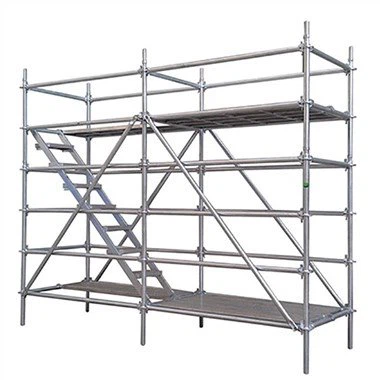
Hey there! As a supplier of Ringlock Scaffolding, I've seen firsthand how crucial quality control is in this industry. In this blog post, I'll share some of the key quality control points for Ringlock Scaffolding that I've learned over the years.
Material Quality
The first and most obvious quality control point is the material used in the scaffolding. The steel used should be of high quality, with the right chemical composition and mechanical properties. We usually use high - strength low - alloy steel, which can withstand heavy loads and harsh environmental conditions.
When we receive the steel from our suppliers, we conduct a series of tests. For example, we check the hardness of the steel. A simple hardness test can tell us if the steel has been properly heat - treated. If the hardness is too low, the scaffolding may deform under load; if it's too high, it may become brittle and prone to cracking.
We also check the thickness of the steel pipes. In Ringlock Scaffolding, the thickness of the pipes affects its load - bearing capacity. We use calipers to measure the thickness at multiple points along the pipe to ensure it meets the specifications. Any deviation from the standard thickness can compromise the safety and performance of the scaffolding.
Manufacturing Process
The manufacturing process of Ringlock Scaffolding is another critical quality control area. First, the cutting of the pipes needs to be precise. The length of each pipe should be accurate within a certain tolerance. We use automated cutting machines that are programmed to cut the pipes to the exact length. After cutting, we check the ends of the pipes to make sure they are smooth and free of burrs, as burrs can cause problems during assembly.
The welding process is also very important. In Ringlock Scaffolding, the rings are welded to the vertical pipes. The welds need to be strong and uniform. We use experienced welders who are trained to follow strict welding procedures. We also conduct non - destructive testing on the welds, such as ultrasonic testing, to detect any internal defects. If a weld has a defect, it can weaken the entire structure of the scaffolding.
Assembly and Fit
Once the individual components are manufactured, the assembly process is where we really see if everything fits together properly. The rings on the vertical pipes should be evenly spaced and perpendicular to the pipe axis. When we assemble the horizontal ledgers to the vertical pipes, the connection should be tight and secure.
We check the fit of the locking mechanisms. In Ringlock Scaffolding, the locking system is what holds the entire structure together. The wedges or pins used for locking should fit snugly into the holes in the rings and ledgers. If the fit is too loose, the scaffolding may come apart during use, which is extremely dangerous.
Surface Treatment
Surface treatment is not only about making the scaffolding look good; it also plays a vital role in protecting it from corrosion. Most of our Ringlock Scaffolding is Galvanized Ringlock Scaffolding, which has a zinc coating on the surface.
We check the thickness of the galvanized layer. A thicker galvanized layer provides better corrosion resistance. We use a coating thickness gauge to measure the thickness at different points on the scaffolding. We also look for any signs of uneven coating or bare spots. If there are bare spots, the steel underneath is exposed to the elements and can rust quickly.
Load - Bearing Capacity
One of the most important aspects of Ringlock Scaffolding is its load - bearing capacity. Before we release a batch of scaffolding for sale, we conduct load tests. We set up a test structure that mimics the real - world conditions in which the scaffolding will be used.
We gradually apply loads to the test structure and monitor its performance. We measure the deflection of the beams and the overall stability of the structure. The scaffolding should be able to withstand the design load without excessive deflection or failure. If the load - bearing capacity does not meet the requirements, we need to find out the cause, whether it's a material issue, a manufacturing defect, or a problem with the design.
Safety Features
Safety is our top priority, so we pay close attention to the safety features of our Ringlock Scaffolding. For example, the guardrails and toe boards are essential for preventing falls. The guardrails should be of the right height and strength. We check the connection of the guardrails to the scaffolding structure to make sure they are firmly attached.


The access ladders on the scaffolding also need to be safe. They should have proper rungs and handrails. We test the ladders to ensure they can support the weight of workers climbing up and down.
Compatibility with Other Components
In many construction projects, Ringlock Scaffolding needs to be used in conjunction with other types of scaffolding or construction equipment. We ensure that our Ringlock Scaffolding is compatible with Ledger Scaffolding and other common construction components.
We test the connection points between different types of scaffolding to make sure they can be easily and securely joined together. This compatibility allows for more flexible and efficient construction setups.
Documentation and Certification
Proper documentation is an important part of quality control. We keep detailed records of the manufacturing process, including the raw material suppliers, the production dates, and the test results. These records can be used for traceability in case there are any quality issues in the future.
We also obtain relevant certifications for our Ringlock Scaffolding. Certifications from recognized standards organizations, such as ISO, indicate that our products meet international quality and safety standards. Customers can have more confidence in our products when they see these certifications.
Inspection and Maintenance Guidelines
As a supplier, we don't just sell the scaffolding and walk away. We provide our customers with inspection and maintenance guidelines. These guidelines include how often the scaffolding should be inspected, what to look for during inspections, and how to perform basic maintenance tasks.
Regular inspections can help detect any potential problems early, such as loose connections or signs of corrosion. By following the maintenance guidelines, customers can extend the lifespan of the scaffolding and ensure its continued safe use.
Conclusion
Quality control for Ringlock Scaffolding is a multi - step process that involves material selection, manufacturing, assembly, and after - sales support. By paying attention to these key quality control points, we can ensure that our Ringlock Scaffolding is safe, reliable, and meets the high standards of the construction industry.
If you're in the market for high - quality Construction Scaffolding, I'd love to talk to you. Whether you have a small project or a large - scale construction job, our Ringlock Scaffolding can meet your needs. Feel free to reach out to discuss your requirements and get a quote.
References
- Construction Scaffolding Standards Handbook
- Steel Material Testing Manuals
- Welding Procedure Specifications for Scaffolding